Content Marketing Statistics 2026: Is Content Still Worth It When AI Answers First? (Data From 192 Marketers)
Straight answers to the questions business owners are asking in 2026: is content marketing still worth it, does AI search kill website traffic, how much should you publish, and what to measure. Built on GoodFirms' survey of 192 marketers, where Softologics was a research partner.
The Short Answer
Yes, content still works in 2026, but the job has changed. GoodFirms surveyed 192 content marketers for its Content Engagement Metrics 2026 research. Despite AI answers taking clicks from Google, 66.3% reported organic traffic growth and 60.9% reported more leads from content.
What changed is where people meet your business and what earns their trust. 65.2% now say AI search and answer engines matter more for distribution, ahead of organic search (56.5%). Buyers often read an AI summary of your industry before they ever see your website.
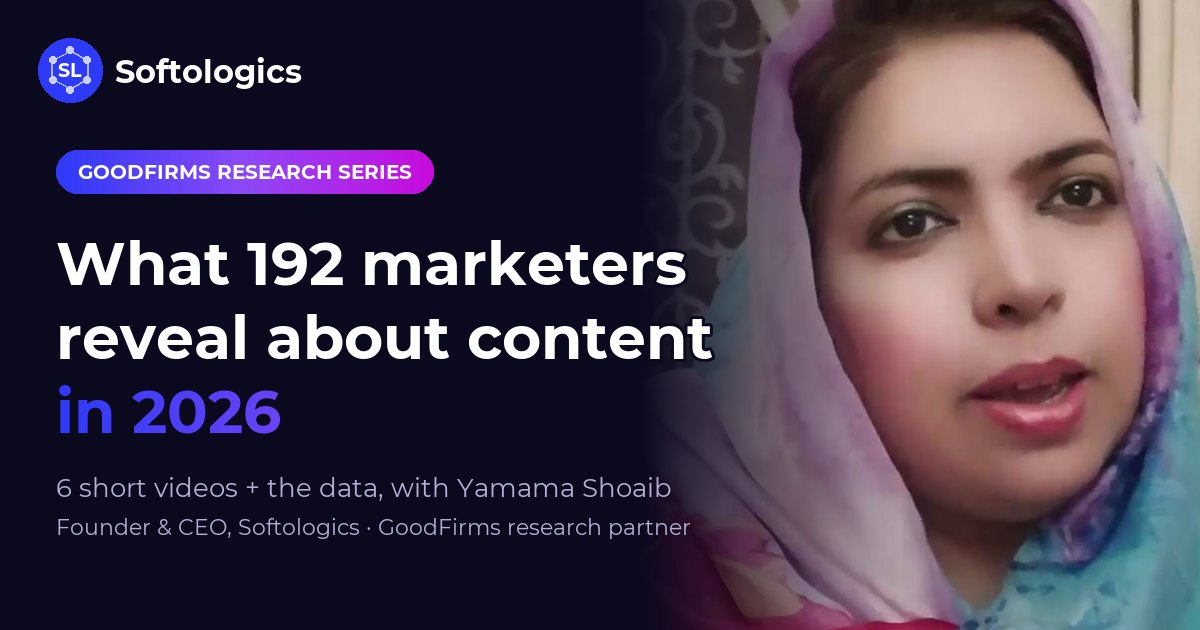
Softologics was a research partner in this study, and our founder, Yamama Shoaib, was featured as an expert in GoodFirms' videos about the findings. The original LinkedIn posts are linked at the end of this article. This guide pulls out the numbers that matter for small businesses and answers the questions we hear most from clients.
Watch the 6-part video series: the key moments from GoodFirms' research videos, each under a minute. See the GoodFirms Research Series
Content Marketing Statistics 2026 at a Glance
| Statistic | Figure |
|---|---|
| Marketers reporting organic traffic growth | 66.3% |
| Reporting content engagement growth | 63% |
| Reporting more content-driven leads or conversions | 60.9% |
| Say AI search / answer engines became more important for distribution | 65.2% |
| Use AI regularly or extensively in content work | 82.6% |
| Optimising content for AI search and answer engines | 60.9% |
| Prioritising expert-led or firsthand content | 58.7% |
| Track website traffic or pageviews | 81.5% |
| Say leads are the strongest sign content worked | 38% |
| Connect engagement to business outcomes very effectively | 26.1% |
| Say blogs and articles drive their strongest engagement | 73.9% |
| Plan distribution before creating content | 55.4% |
Source: GoodFirms, Content Engagement Metrics 2026, 192 respondents.
Is Content Marketing Still Worth It in 2026?
For most service businesses, yes. The survey results surprised even GoodFirms, which expected 2026 to be a bad year for content:
- 38% saw a significant increase in organic traffic and another 28.3% saw some increase (66.3% combined)
- 63% reported content engagement growth
- 60.9% reported more leads or conversions from content
- Only 21.7% said engagement stayed about the same
The pain is real in one group: publishers. A Growth Memo analysis of Similarweb data (10,000 US and French domains, cited in the report) found publishers lost roughly 42% of organic traffic in two years. When your product is information, AI answers compete with you directly.
A roofer, dentist or consultant is in a different position. Your content's job isn't to be the information. It's to prove you're the right business to call. That job still works.
Does AI Search Reduce Website Traffic?
It reduces clicks on many searches. The report cites two numbers every business owner should know:
- Ahrefs analysed 300,000 keywords and found Google AI Overviews led to a 34.5% lower click-through rate for the top-ranking page.
- Pew Research Center found users clicked a traditional search result on 8% of visits when an AI summary appeared, versus 15% without one. Links inside the AI summary were clicked on only 1% of visits.
So people still search, but more of them get the answer without visiting. That's why 65.2% of marketers now treat AI search and answer engines as a more important channel, ahead of organic search/SEO (56.5%) and LinkedIn (53.3%).
"What happens when your website ranks on Google, but people get answers directly from AI and never get the chance to visit your website? That's the reality marketers need to think about." Yamama Shoaib, Founder & CEO of Softologics, in GoodFirms' research video
What to do about it: aim to be named in the answer, not just ranked under it. We cover the practical steps in our guide to generative engine optimization for small businesses and zero-click SEO.
How Do I Get My Business Mentioned in AI Answers?
The marketers already doing this told GoodFirms what they're changing. 60.9% are optimising for AI search, and their strategies are about authority, not tricks:
| Strategy | % of marketers |
|---|---|
| Prioritising expert-led or firsthand content | 58.7% |
| Investing more in brand-building and authority | 57.6% |
| Producing original research or proprietary data | 47.8% |
| Updating existing content more often | 37% |
| Diversifying where content is distributed | 31.5% |
For a small business, that translates into five concrete moves:
- Answer real customer questions on your site, in plain language, with the answer in the first two sentences.
- Add proof only you have: photos of your work, real prices, local details, named team members.
- Keep your business details identical on your website, Google Business Profile and directories.
- Earn mentions on other sites: reviews, directory profiles, local press, industry research like this one.
- Use structured data so machines can read who you are. Our schema markup guide explains it without jargon.
"Share your experience, bring original insights, answer real customer questions, and give people a reason to trust your brand." Yamama Shoaib, in GoodFirms' research video
How Often Should a Small Business Publish Content?
Less often than you think, if each piece is better. This was one of the clearest findings in the study:
| Production strategy | Traffic growth | Engagement growth | Lead growth |
|---|---|---|---|
| Producing more content overall | 73.5% | 73.5% | 61.8% |
| Fewer pieces, more investment in each | 73.3% | 80% | 66.7% |
Traffic growth was almost identical. The fewer-but-better group reported somewhat stronger engagement and leads, though GoodFirms notes that subgroup is small, so treat it as a direction rather than proof.
Overall, 46.7% of marketers are now holding or cutting volume to focus on quality. The #1 content challenge is standing out (22.8%), not producing enough.
Our rule for clients: if a competitor in another city could publish the same page by swapping the town name, it isn't worth publishing. Two genuinely useful posts a month will outperform ten generic ones.
What Content Formats Work Best in 2026?
Blogs are not dead. They're still the top format by a wide margin:
- Blogs and articles: 73.9%
- Case studies: 47.8%
- Social media content: 33.7%
- Original research and reports: 28.3%
- Short-form video: 28.3%
The pattern behind the list: formats that show real experience (case studies, original data) are gaining because AI can summarise generic explanations but can't invent your results. Our own case studies publish real Google Search Console numbers, including the flat months, for exactly this reason.
How Do You Measure Content Engagement?
Use three levels. Each answers a different question:
| Level | Question it answers | Metrics |
|---|---|---|
| Attention | Was the content found? | Traffic, impressions, reach |
| Interaction | Did people respond? | Clicks, time on page, return visits, subscriptions |
| Outcome | Did it create value? | Leads, calls, quote requests, sales |
Most marketers track the first level and judge by the third. 81.5% track traffic, but when asked for the strongest sign that content worked, 38% chose leads and 22.8% chose conversions or revenue.
The gap is attribution. Only 26.1% connect content engagement to business outcomes very effectively. Another 38% do it somewhat effectively.
"Are people engaging with your content? Are they coming back? Do they trust your expertise enough to choose your business? Because ultimately, visibility might get you noticed. But trust is what makes people remember you." Yamama Shoaib, in GoodFirms' research video
Three numbers a small business should check every month:
- Enquiries from the website (forms, calls, quote requests)
- Branded searches: how many people search your business name (in Google Search Console)
- Returning visitors: people who come back are people who are deciding
Do Repurposing, AI and Brand Authority Really Help?
The survey found a clear pattern. Teams with these habits reported more lead growth:
| Habit | Lead growth | Others |
|---|---|---|
| Focused on business outcomes | 75.8% | 52.4% |
| Use AI extensively | 74.4% | 50.9% |
| Repurpose content routinely | 71.7% | 51% |
| Invest in brand authority | 69.4% | 51.1% |
GoodFirms is careful to say these are associations, not proof. Stronger teams may simply do all of these things at once. But the direction is consistent: content works better as a system (plan, publish, reuse, measure) than as a stream of one-off posts.
Repurposing is the cheapest habit to start. This article is an example: one research study became six short videos, a video page and this guide.
What This Means for Your Business
If you run a small business, the 2026 data says:
- Don't stop publishing. Most marketers still grew traffic and leads.
- Publish less, prove more. Firsthand experience beats volume.
- Plan for AI answers. Be the business the summary names.
- Build trust off your site too. Reviews, profiles and mentions matter.
- Measure enquiries, not just visits.
Not sure how your business looks to Google and AI tools right now? We'll check your website, Google profile and reviews and send you a plain-English fix list. Get a free website audit.
Frequently Asked Questions
Is content marketing still worth it in 2026?
Yes, for businesses that use content to win customers. In GoodFirms' 2026 survey of 192 marketers, 66.3% reported organic traffic growth and 60.9% reported more content-driven leads, even with AI search on the rise.
Does AI search reduce website traffic?
It reduces clicks on many searches. Pew found users clicked a traditional result on 8% of visits when a Google AI summary appeared, versus 15% without one. But most marketers in the GoodFirms survey still grew traffic, so the impact depends on your business type.
How often should a small business publish blog posts?
Volume matters less than value. Teams publishing more content reported traffic growth 73.5% of the time, versus 73.3% for teams publishing fewer, better-funded pieces. In our experience, two useful posts a month beat ten generic ones.
What is the best way to measure content engagement?
Measure in three levels: attention (traffic, impressions), interaction (clicks, time, return visits) and outcome (leads, calls, sales). In the survey, 38% named leads the strongest sign content worked, ahead of traffic.
How do I get my business mentioned in ChatGPT or Google AI Overviews?
Publish clear pages that answer real customer questions, add firsthand experience and proof, keep your business details consistent across Google and directories, and earn reviews and mentions on other sites. AI tools favour sources they can verify.
Which content formats get the most engagement in 2026?
Blogs and articles ranked first at 73.9%, followed by case studies (47.8%), social media content (33.7%), and original research and short-form video (28.3% each).
See the Original Posts on LinkedIn
Everything above is public. You can check it at the source.
GoodFirms' posts featuring Yamama Shoaib:
- We expected 2026 to be a bad year for content (192 marketers)
- The riskiest content in 2026 is the competent kind
- Content marketing has two AI camps
- Rankings and clicks used to tell the whole story
Yamama's own posts about the feature:
- Honored to be featured by GoodFirms: give people a reason to trust your brand
- Stop creating content just to rank: rethinking how we measure success
- Grateful to be part of the conversation: sharing GoodFirms' 192-marketer study
Follow Yamama Shoaib on LinkedIn for weekly, plain-English takes on SEO, AI search and small-business websites: linkedin.com/in/yamama-shoaib-9bab8732
About This Research
All statistics come from GoodFirms' Content Engagement Metrics 2026: What 192 Marketers Reveal, based on 192 survey responses from content strategy, marketing and measurement professionals. Third-party figures (Ahrefs, Pew Research Center, Growth Memo) are as cited in that report. Softologics was a research partner. Yamama Shoaib's quotes are from GoodFirms' LinkedIn videos about the research, not from the written report.
Watch the videos: GoodFirms Research Series · See all our press and recognition.
Related resources from Softologics
Explore our SEO services for roofing companies, our digital marketing agency for USA businesses, or browse our free SaaS tools. Ready to grow? Visit our contact page.
SEO & website design for roofing companies
Page 1 rankings and a converting website built for USA roofers.
Digital marketing agency for USA businesses
SEO, content, and conversion strategy for small businesses in the USA.
Professional company profile design
Premium brand profiles that attract high-value clients and investors.
Free SaaS tools — TTS, video converter & more
Text-to-speech, video to audio, and bulk email tools. All free.
Related blog posts
More guides on SEO, digital marketing strategy, and business growth.
How Much Does a Website Cost in the USA? 2026 Prices, Timelines & What to Ask
Straight answers to what US business owners actually search: what a website costs in 2026, how long it takes, builder vs freelancer vs agency, the ongoing costs nobody mentions, and two live sites we built so you can judge for yourself.
What Is Schema Markup? The Plain-English Guide for US Businesses (2026)
Schema markup explained without jargon — what it is, why it matters more in AI search than it ever did for SEO, the types your business actually needs, and how to check what you already have.
AI Agents vs Agentic AI: What US Business Owners Actually Need to Know (2026)
The difference between AI agents and agentic AI, in plain English — what they really do, realistic costs for US businesses, the tasks worth automating first, and the honest failure modes nobody advertises.